For US Healthcare Professionals
Proven safe and generally well tolerated
You and your patients can have confidence in the safety profile of LOKELMA1
INDICATION AND LIMITATION OF USE
LOKELMA is indicated for the treatment of hyperkalemia in adults.
LOKELMA should not be used as an emergency treatment for life-threatening hyperkalemia because of its delayed onset of action.

- SAFETY FOR ADULT PATIENTS NOT ON DIALYSIS
- SAFETY FOR ADULT PATIENTS ON DIALYSIS
Patients in LOKELMA clinical trials had comorbidities similar to your patient population1,3





Low rates of edema were seen in clinical trials1
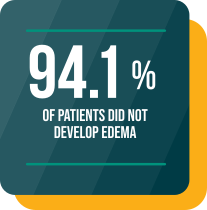
on the 10 g qd recommended maintenance dose for up to 28 days1
Adverse events
Edema
- In clinical trials of LOKELMA, edema was generally mild to moderate in severity1
- In placebo-controlled trials in which patients were treated with once-daily doses of LOKELMA for up to 28 days1:
LOKELMA |
Placebo |
||
|---|---|---|---|
5 g qd |
10 g qd |
15 g qd |
2.4% |
4.4% |
5.9% |
16.1% |
|
- 0.2% of patients (1/479) discontinued LOKELMA due to edema4*
- In longer-term, uncontrolled trials, in which most patients were maintained on doses <15 g qd, edema (including edema, generalized edema, and peripheral edema) was reported in 8% to 11% of patients1
Constipation
- In a pooled analysis of clinical studies conducted in countries with a predominantly Asian population, constipation occurred in patients receiving LOKELMA with an estimated incidence of 9% and 5% for the 10 g and 5 g dose respectively. Constipation was resolved with dose adjustment or treatment discontinuation. No cases of constipation were reported in patients receiving placebo1
Hypokalemia
- 4.1% of LOKELMA-treated patients developed hypokalemia with a serum K+ value of <3.5 mEq/L, which resolved with dose reduction or discontinuation of LOKELMA1
*During the maintenance phase, 1 patient who received 15 g LOKELMA qd was withdrawn due to general edema. There were no patient discontinuations due to edema for the initial phases of the trials.
IMPORTANT SAFETY INFORMATION FOR LOKELMA® (sodium zirconium cyclosilicate)
WARNINGS AND PRECAUTIONS:
- Gastrointestinal Adverse Events in Patients with Motility Disorders: Avoid LOKELMA in patients with severe constipation, bowel obstruction or impaction, including abnormal post-operative bowel motility disorders. LOKELMA has not been studied in patients with these conditions and it may be ineffective and may worsen gastrointestinal conditions
- Edema: Each 5-g dose of LOKELMA contains approximately 400 mg of sodium, but the extent of absorption by the patient is unknown. In clinical trials of LOKELMA in patients who were not on dialysis, edema was observed and was generally mild to moderate in severity and was more commonly seen in patients treated with 15 g once daily. Monitor for signs of edema, particularly in patients who should restrict their sodium intake or are prone to fluid overload (eg, heart failure or renal disease). Advise patients to adjust dietary sodium, if appropriate. Increase the dose of diuretics as needed
In a clinical trial of LOKELMA in patients on chronic hemodialysis in which most patients were treated with doses of 5 g to 10 g once daily on non-dialysis days, there was no difference in the mean change from baseline in interdialytic weight gain (a measure of fluid retention) between the LOKELMA and placebo groups
- Hypokalemia in Patients on Hemodialysis: Patients on hemodialysis may be prone to acute illness that can increase the risk of hypokalemia on LOKELMA (eg, illnesses associated with decreased oral intake, diarrhea). Consider adjusting LOKELMA dose based on potassium levels in these settings
Learn about dosing for patients across all settings
REVIEW DOSINGThe safety of LOKELMA was comparable to placebo for patients on dialysis3
Adverse events
Overall, 40 patients in the LOKELMA group (41.7%) reported adverse events, compared to 46 patients in the placebo group (46.5%)1,3
LOKELMA (n=97) |
Placebo (n=99) |
|
|---|---|---|
GI disorders
|
19.8%
|
17.2%
|
Infections
|
12.5%
|
9.1%
|
Overall SAEs
|
7.3%
|
8.1%
|
- In Study 4, in which most patients were treated with doses of 5 g to 10 g once daily on non-dialysis days, there was no difference in the mean change from baseline in interdialytic weight gain (a measure of fluid retention) between the LOKELMA and placebo groups1
Constipation
- In a pooled analysis of clinical studies conducted in countries with a predominantly Asian population, constipation occurred in patients receiving LOKELMA with an estimated incidence of 9% and 5% for the 10 g and 5 g dose respectively. Constipation was resolved with dose adjustment or treatment discontinuation. No cases of constipation were reported in patients receiving placebo1
Hypokalemia
- 5% of patients developed predialysis hypokalemia (serum K+ <3.5 mEq/L) in both the LOKELMA and placebo groups; 3% and 1% of patients developed a serum K+ <3.0 mEq/L in the LOKELMA and placebo groups, respectively1
Other adverse events
- The most common SAEs were angina pectoris (2.1%) in the LOKELMA group and hyperkalemia requiring rescue therapy (3%)* and fluid overload (2%) in the placebo group3 – None of the SAEs were related to the study drug3
*Use of rescue therapy included, but was not limited to, insulin/glucose, sodium bicarbonate, β-adrenergic agonists, K+ binders (sodium polystyrene sulfonate, calcium polystyrene sulfonate, patiromer) and any other form of renal replacement therapy, including additional dialysis or reduction in dialysate K+ concentration.3
IMPORTANT SAFETY INFORMATION FOR LOKELMA® (sodium zirconium cyclosilicate)
WARNINGS AND PRECAUTIONS:
- Gastrointestinal Adverse Events in Patients with Motility Disorders: Avoid LOKELMA in patients with severe constipation, bowel obstruction or impaction, including abnormal post-operative bowel motility disorders. LOKELMA has not been studied in patients with these conditions and it may be ineffective and may worsen gastrointestinal conditions
- Edema: Each 5-g dose of LOKELMA contains approximately 400 mg of sodium, but the extent of absorption by the patient is unknown. In clinical trials of LOKELMA in patients who were not on dialysis, edema was observed and was generally mild to moderate in severity and was more commonly seen in patients treated with 15 g once daily. Monitor for signs of edema, particularly in patients who should restrict their sodium intake or are prone to fluid overload (eg, heart failure or renal disease). Advise patients to adjust dietary sodium, if appropriate. Increase the dose of diuretics as needed
In a clinical trial of LOKELMA in patients on chronic hemodialysis in which most patients were treated with doses of 5 g to 10 g once daily on non-dialysis days, there was no difference in the mean change from baseline in interdialytic weight gain (a measure of fluid retention) between the LOKELMA and placebo groups
- Hypokalemia in Patients on Hemodialysis: Patients on hemodialysis may be prone to acute illness that can increase the risk of hypokalemia on LOKELMA (eg, illnesses associated with decreased oral intake, diarrhea). Consider adjusting LOKELMA dose based on potassium levels in these settings
Learn about dosing for patients across all settings
REVIEW DOSING