For US Healthcare Professionals
Proven efficacy in a broad range of patients1
Choose LOKELMA to treat hyperkalemia1
INDICATION AND LIMITATION OF USE
LOKELMA is indicated for the treatment of hyperkalemia in adults.
LOKELMA should not be used as an emergency treatment for life-threatening hyperkalemia because of its delayed onset of action.

- ADULT PATIENTS NOT ON DIALYSIS
- ADULT PATIENTS ON DIALYSIS
LOKELMA is proven to help patients achieve and maintain normal K+ levels1

Rapid reductions in serum K+ levels1
LOKELMA is the only K+ binder with reductions measured in as early as 1 hour1,3-5*
Primary endpoint was met: Demonstrating a greater reduction in serum K+ levels over the 48-hour initial treatment period with LOKELMA 10 g tid compared to placebo (P<0.001).1,3
*IN STUDY 1: In as early as 1 hour after the first dose of LOKELMA 10 g, reduction in K+ levels was observed in patients. The study met its primary endpoint, demonstrating a greater reduction in serum K+ levels over the 48-hour initial treatment period with LOKELMA 10 g tid compared to placebo (P<0.001).1,3
Limitation of Use: LOKELMA should not be used as an emergency treatment for life-threatening hyperkalemia because of its delayed onset of action.
STUDY 1: Mean serum K+ in the initial phase over 48 hours3
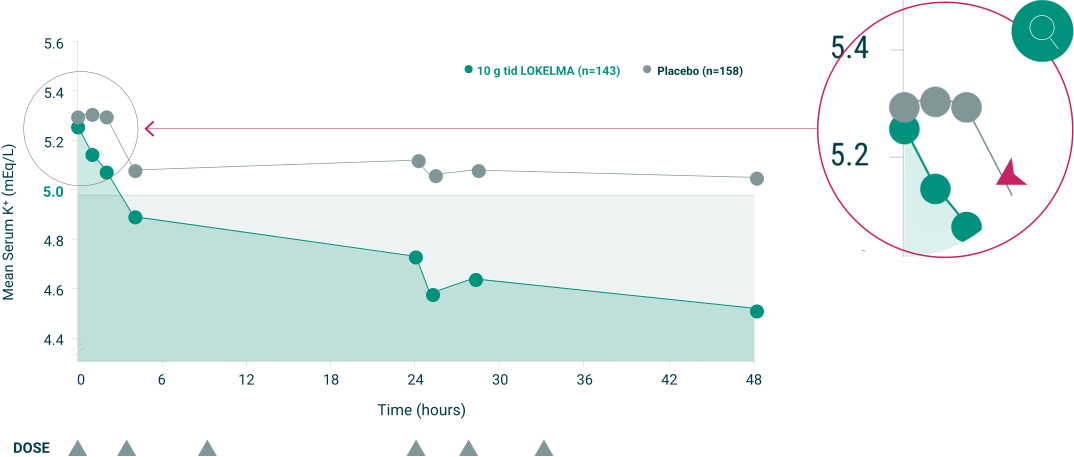
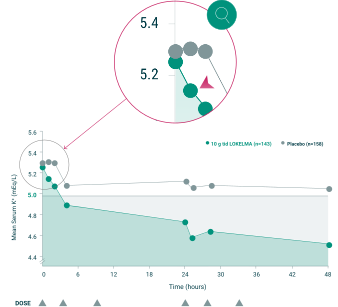
IN STUDY 1, reduction in K+ levels was observed in patients after first dose of LOKELMA 10 g as early as 1 hour.3
Limitation of Use: LOKELMA should not be used as an emergency treatment for life-threatening hyperkalemia because of its delayed onset of action.
STUDY 1 DESIGN: In the initial phase of a multicenter, two-part, double-blind, randomized, placebo-controlled, Phase 3 trial, 753 patients received placebo or 1.25 g, 2.5 g, 5 g, or 10 g LOKELMA tid for the initial 48 hours.1,3

Sustained reductions in serum K+ levels1
LOKELMA sustained† normokalemia‡ with continued treatment for up to 1 year1,6,7
IN STUDY 2: LOKELMA-treated patients (n=258) with hyperkalemia who achieved normokalemia‡ at 48 hours were included in the double-blind, randomized, maintenance phase of the study.1,6
†Primary endpoint was met: Mean serum K+ levels on Days 8-29 were lower with LOKELMA 5 g, 10 g, and 15 g vs placebo (4.8 mEq/L, 4.5 mEq/L, and 4.4 mEq/L vs 5.1 mEq/L, respectively; P≤0.001 for all doses).1,6
IN STUDY 2 EXTENSION: Patients (N=123) who continued LOKELMA in the open-label extension phase sustained† normokalemia‡ for up to 11 months.1,7
‡Normokalemia was defined as K+ levels between 3.5 mEq/L and 5.0 mEq/L.1,6,7
STUDY 2: Mean serum K+ in the initial phase at 48 hours1,6
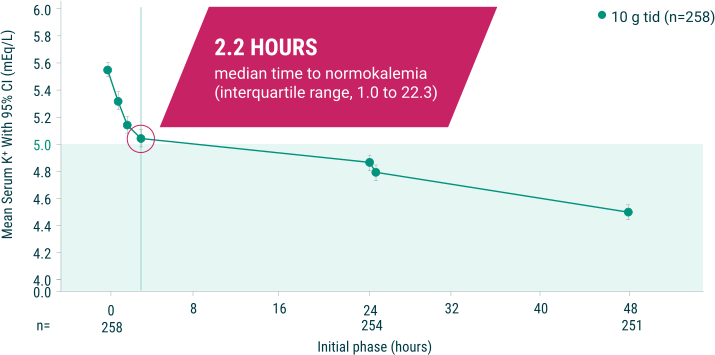
Average serum K+ levels decreased from 5.6 mEq/L to 4.5 mEq/L with LOKELMA 10 g tid for 48 hours1,6
STUDY 2 EXTENSION: Mean serum K+ levels in patients who completed a 28-day randomized maintenance phase and continued on LOKELMA for 11 months1
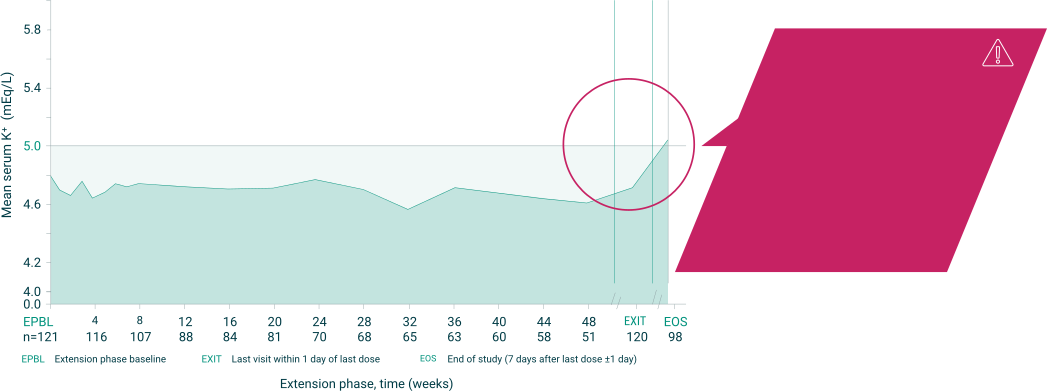
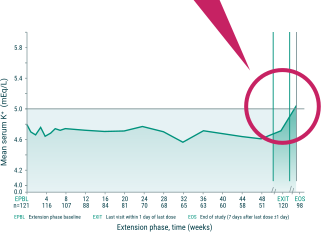
Discontinuing LOKELMA resulted in increased K+ levels

~17% of patients had serum K+ levels over 5.5 mEq/L in only 7 days7
STUDY 2 DESIGN: After the open-label initial phase of a multicenter, two-part, Phase 3 trial, in which 258 patients received 10 g LOKELMA tid for 48 hours, patients who achieved normokalemia were randomized to receive 5 g, 10 g, or 15 g LOKELMA or placebo once daily for 28 days in the maintenance phase. 123 patients who completed the maintenance phase participated in the 11-month, open-label extension study.1,6
STUDY 2 EXTENSION DESIGN: Patients who were included in the 28-day randomized maintenance phase of Study 2 had the option to continue treatment with LOKELMA in an open-label extension phase for up to 11 months (N=123). The LOKELMA dose was titrated in 5-g increments (to 5 g qod up to 15 g qd) based on i-STAT K+ levels.1,7
Treating HK may enable guideline-recommended RAASi therapy8,9
In a prespecified exploratory analysis of Study 3,
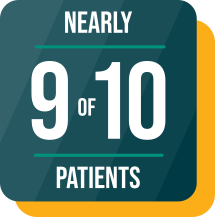
In a prespecified exploratory analysis of Study 3,
continued RAASi therapy while taking LOKELMA long term.10
In the 483 patients on RAASi therapy at baseline, during the maintenance phase of Study 3, a 12-month, open-label study evaluating LOKELMA in patients with hyperkalemia:
- 74% of patients had no change in RAASI dose
- 13% had an increase in RAASi dose§
- 14% had a decrease in RAASi dose§
- 11% of patients discontinued RAASi
Among 263 RAASi-naïve participants, 14% initiated RAASi therapy.
The primary endpoints included the percentage of patients who achieved normokalemia (K+=3.5–5.0 mEq/L), during the initial phase (n=746; 99%) and the percentage of patients who maintained mean serum K+ ≤5.1 mEq/L during Months 3-12 of the maintenance phase (achieved by 88%). The mean baseline K+ was 5.6 mEq/L.1,10
§Patients were counted more than once if they required more than 1 RAASi adjustment, so the total percentage across all 4 categories may exceed 100%.10
STUDY 3 DESIGN: LOKELMA was evaluated for long-term efficacy in 751 patients with hyperkalemia in an open-label, single-arm, 12-month, Phase 3 study. Following the initial-phase treatment of LOKELMA 10 g tid, patients who achieved normokalemia (K+=3.5–5.0 mEq/L) within 72 hours (n=746; 99%) entered the maintenance phase. For maintenance treatment, the initial dose of LOKELMA was 5 g qd and was adjusted to a minimum of 5 g qod up to a maximum of 15 g qd, based on i-STAT K+ level. The primary endpoints included the percentage of patients who achieved normokalemia during the initial phase and the percentage of patients who maintained mean serum K+ ≤5.1 mEq/L during Months 3-12 of the maintenance phase (achieved by 88% of patients).1,10 89% of patients continued RAASi use while taking LOKELMA.10 RAASi therapy included ACEi, ARB, and MRA.10
Review the real-world evidence study that evaluated long-term vs short-term use of LOKELMA
SEE THE REAL-WORLD DATAChoose a treatment proven to be safe and generally well tolerated
REVIEW THE SAFETY PROFILE FOR LOKELMALOKELMA achieved and sustained lower predialysis K+ levels vs placebo1,3
LOKELMA is the only FDA-approved K+ binder with efficacy and safety results and dosing information in the label for adult patients with hyperkalemia on chronic hemodialysis1
STUDY 4:
- 41% of patients treated with LOKELMA (n=97) achieved the primary endpoint compared to 1% of patients in the placebo group (n=99; P<0.001)1,3
- Responders maintained predialysis serum K+ between 4.0–5.0 mEq/L during at least 3 of 4 hemodialysis treatments after the LIDI and did not receive rescue therapy* during the evaluation period1,3
LOKELMA sustained lower predialysis K+ levels in patients on hemodialysis with continued treatment1
*Rescue therapy was defined as any urgent therapeutic intervention considered necessary to reduce serum K+ in the setting of severe hyperkalemia (defined by protocol as >6.0 mEq/L). Rescue therapy use was left to the investigator's clinical judgment to be given in accordance with local practice guidelines.3
Mean predialysis serum K+ levels over time in patients on chronic hemodialysis1
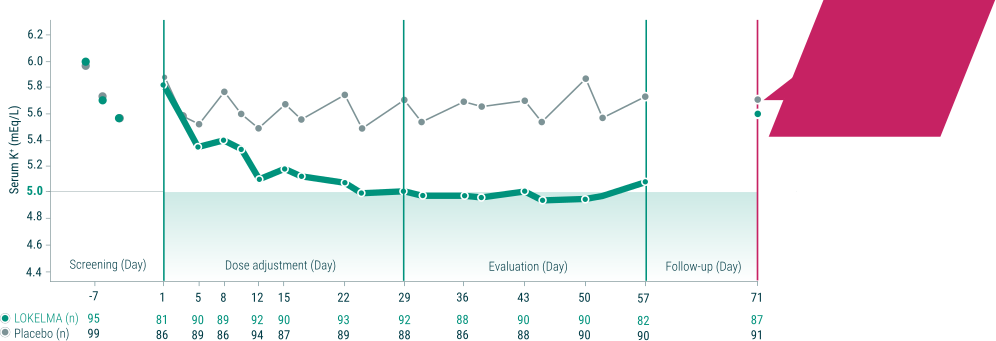
Serum K+ levels elevated after treatment discontinued
STUDY 4 DESIGN: DIALIZE was a double-blind, placebo-controlled trial in patients with end-stage kidney disease on chronic hemodialysis (≥3 months) and persistent hyperkalemia† (n=196) who were randomized to receive LOKELMA 5 g or placebo once daily on non-dialysis days. In the initial 4-week period the dose could be adjusted weekly in 5-g increments up to 15 g qd on non-dialysis days to achieve predialysis serum K+ levels between 4.0 mEq/L and 5.0 mEq/L after the LIDI. The dose at the end of the dose-adjustment period was maintained throughout the 4-week evaluation period. Baseline mean predialysis serum K+ levels after the LIDI were 5.8 mEq/L in the LOKELMA group and 5.9 mEq/L in the placebo group.1,3
†Persistent hyperkalemia defined as predialysis serum K+ >5.4 mEq/L after the LIDI and >5.0 mEq/L after at least one SIDI.3
Choose a treatment proven to be safe and generally well tolerated
REVIEW THE SAFETY PROFILE FOR LOKELMA